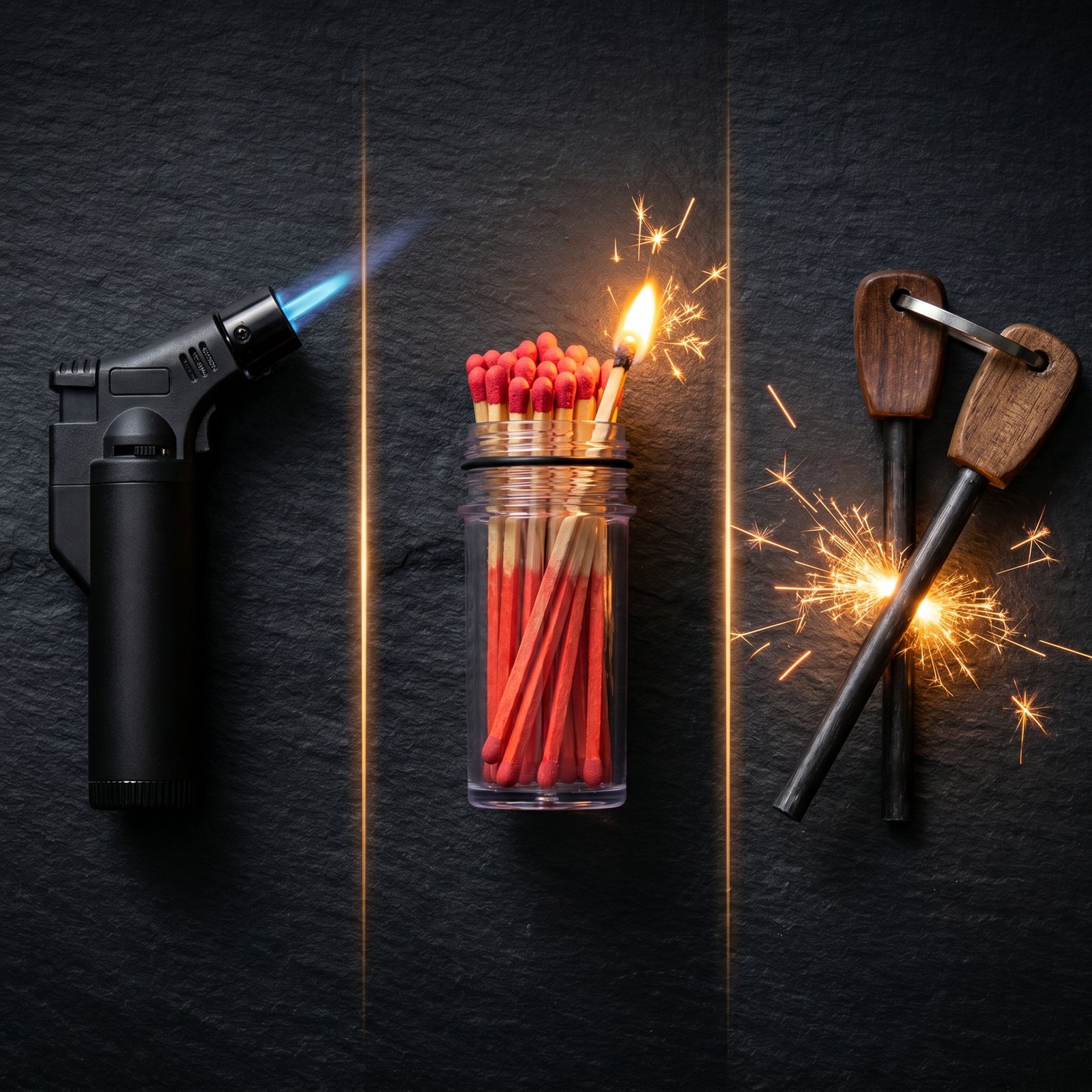

It’s the great debate that divides campers, preppers, and survival enthusiasts around every campfire: when it comes to making fire, which tool reigns supreme? The humble lighter, slipped into a million pockets worldwide? The classic match, humanity’s reliable companion for generations? Or the rugged ferro rod, beloved by bushcrafters for throwing molten sparks in the worst conditions imaginable? Ask three outdoors people and you’ll get three passionate, conflicting answers.
The truth is that this isn’t a simple question with a single winner — and anyone who tells you otherwise is oversimplifying. Each of these three fire-starting methods has genuine strengths and real weaknesses, and the “best” choice depends entirely on your situation, your environment, your budget, and how you plan to use it. A tool that’s perfect for lighting a backyard fire pit might be useless on a freezing mountaintop, and vice versa.
That’s exactly why we’re settling this debate properly. In this head-to-head comparison, we’ll break down lighters, matches, and ferro rods across every factor that matters — reliability, wet-weather performance, ease of use, lifespan, cost, and more. By the end, you’ll know precisely which tool fits your needs, and more importantly, why the smartest adventurers don’t choose just one. Let’s settle this once and for all. 🔥
Before we pit these tools against each other, let’s properly introduce each contender so you understand what makes them tick. Each represents a fundamentally different approach to creating fire, with its own underlying technology and philosophy.
The lighter delivers fire at the push of a button or flick of a wheel, producing an instant flame fed by butane or fluid, or in modern electric versions, a flameless plasma arc. It’s the convenience champion — fast, easy, and familiar — ranging from cheap disposables to rugged windproof torch models built for the outdoors.
The match is fire-starting in its most elegant, self-contained form: a small stick tipped with a combustible head that ignites with friction. From ordinary kitchen matches to heavy-duty stormproof versions that burn through wind and water, matches require no fuel reservoir or mechanism, just a strike surface and a steady hand.
The ferro rod is the survivalist’s favorite, a rod of ferrocerium that throws a shower of intensely hot sparks when scraped with a sharp striker. It carries no flame of its own but ignites proper tinder reliably, working soaking wet, at any altitude, and for thousands of strikes — making it the gold standard for serious survival fire-starting.
When your safety depends on making fire, reliability is arguably the most important factor, so let’s start here. How dependably does each tool produce fire when you need it, strike after strike?
The ferro rod wins this round decisively for serious conditions. With no fuel to run dry, no mechanism to fail, and no battery to die, it produces hot sparks consistently for thousands of strikes regardless of weather, altitude, or temperature. As long as you have a striker and tinder, it simply works — which is precisely why it’s the backbone of survival kits.
The lighter is highly reliable in everyday conditions but has failure points: it can run out of fuel, malfunction, struggle in extreme cold, or fail at high altitude, and electric models depend on a charged battery. The match is reliable when dry and fresh, but ordinary matches fail when damp and are a finite, consumable resource — though quality stormproof versions dramatically improve their wet-weather dependability. For sheer fail-proof consistency in any condition, the ferro rod takes the crown.
Winner: Ferro Rod
Reliability means little if a tool is so difficult to use that you can’t make fire when you’re cold, tired, or panicked. This round is all about how quickly and easily each method delivers fire, especially for beginners.
The lighter is the runaway winner for ease of use. A single press or flick produces an instant, sustained flame with virtually no skill required — anyone can do it on the first try. This effortless simplicity makes the lighter ideal for quick tasks and for moments when cold, clumsy hands or stress leave no room for technique.
The match comes in second, requiring only a simple strike to produce flame, though it demands slightly more care to strike correctly and shield from wind. The ferro rod is the most skill-intensive of the three, requiring proper technique, a prepared tinder nest, and practice to use effectively — a beginner may struggle without preparation. While that skill is well worth learning, for pure plug-and-play simplicity, nothing beats a lighter.
Winner: Lighter
The wilderness rarely offers ideal conditions, so how each tool performs in rain, wind, and damp is a critical real-world test. This is where the differences between these tools become dramatic.
The ferro rod dominates again here. Because it produces sparks rather than a fragile flame, wind is no obstacle, and it works perfectly even when soaking wet — you can dunk it in water, shake it off, and it sparks just fine. This wet-and-windy invincibility is the core reason survivalists trust it above all else in genuinely bad conditions.
The lighter varies enormously by type: cheap disposables fail in wind and struggle when wet or cold, while windproof torch and plasma arc models perform far better, with arc lighters being completely windproof. Matches depend entirely on type — ordinary matches fail in wind and rain, but quality stormproof matches burn fiercely through both, some even reigniting after submersion. For all-condition resilience, though, the ferro rod’s spark-based approach is hard to beat.
Winner: Ferro Rod (with stormproof matches and torch/arc lighters as strong contenders)
How long will each tool keep making fire before it’s exhausted? This round examines the longevity and total number of fires you can expect from each method.
The ferro rod wins this category by an enormous margin. A quality full-size ferro rod delivers thousands of strikes, meaning a single one can serve you reliably for years of regular use before wearing down. This incredible longevity, combined with needing no fuel, makes it the most enduring fire source you can carry.
The lighter offers many ignitions per fuel charge or battery cycle — often hundreds — and refillable or rechargeable models extend this indefinitely with maintenance, though disposables are eventually discarded. Matches are strictly finite, with each match good for a single use, so your total fires are limited by how many you carry. For sheer number of uses from a single compact tool, the ferro rod stands far above the rest.
Winner: Ferro Rod
Budget matters, so let’s compare what each tool costs upfront and over time, factoring in how much fire-starting capability you get for your money. Value isn’t just the sticker price — it’s the cost per fire over the tool’s lifespan.
The ferro rod offers exceptional long-term value. While a quality rod costs a bit more upfront than a basic lighter or match pack, its thousands of strikes mean the cost per fire is extraordinarily low, and it never needs fuel — making it remarkably economical over years of use. For long-term value, it’s the clear leader.
The lighter is cheap to buy, especially disposables, and refillable models offer good value over time with inexpensive butane, though ongoing fuel or charging is required. Matches are inexpensive per pack, but because each is single-use, the cost-per-fire of frequent use adds up, and quality stormproof matches cost more per stick. Considering longevity and zero fuel needs, the ferro rod again delivers the best overall value, with refillable lighters close behind.
Winner: Ferro Rod (refillable lighters a close second)
How easy is each tool to carry, store, and have ready at a moment’s notice? This round weighs the everyday practicality and pocketability of each method.
The lighter takes this round for sheer grab-and-go convenience. It’s compact, self-contained, requires no separate components, and delivers fire instantly with one hand — slip it in a pocket and you’re ready. For everyday carry and effortless access, nothing is more convenient than a good lighter.
The match is lightweight and compact too, though it requires a strike surface and dry storage, and a waterproof case adds a little bulk for reliability. The ferro rod is durable and compact but typically requires a separate striker and, crucially, prepared tinder to be useful, making it slightly less plug-and-play than a lighter. For instant, one-handed, carry-anywhere convenience, the lighter wins this round.
Winner: Lighter
Let’s tally where each tool stands across our six rounds, keeping in mind that the “best” depends heavily on your specific needs and conditions.
The ferro rod claims victory in reliability, wet-weather performance, lifespan, and overall value — making it the undisputed champion for serious survival and worst-case conditions. Its only weaknesses are a learning curve and the need for separate tinder, but its all-condition dependability is unmatched.
The lighter wins ease of use, portability, and everyday convenience, making it the best choice for daily tasks and quick, hassle-free fire in normal conditions. Its weaknesses — fuel dependence and cold/altitude struggles — matter less in everyday life. The match, meanwhile, rarely wins a category outright but serves as an excellent, simple backup, especially in quality stormproof form. The scorecard reveals not a single winner, but three tools optimized for different priorities.
Here’s the insight that resolves the entire debate: experienced survivalists and seasoned campers don’t actually choose just one of these tools — they carry all three. The cardinal rule of fire preparedness is redundancy, and these three methods complement each other almost perfectly.
The logic is simple but powerful. Carry a lighter for fast, effortless everyday fire-starting when conditions are normal. Add stormproof matches as a simple, reliable backup that works when wet and windy. And include a ferro rod as your fail-proof, fuel-free insurance that keeps working for thousands of strikes in any condition, even if your lighter dies and your matches run out. Round it out with quality waterproof tinder, and you have a layered system that virtually guarantees you can always make fire.
This redundant approach means no single failure ever leaves you in the cold. Each tool covers the others’ weaknesses: the lighter’s convenience, the matches’ simplicity, and the ferro rod’s bombproof reliability combine into a complete fire-starting system far stronger than any one tool alone. That’s why the real answer to “which is best?” is, for any serious adventurer, all of them.
That said, if you’re choosing where to focus based on your specific use case, here’s how to think about it. Your environment and activities should guide which tool you prioritize, even within a redundant kit.
For everyday carry and casual use — lighting candles, grills, and campfires in normal conditions — a quality refillable or windproof lighter is your best primary tool for its sheer convenience. For serious survival, bushcraft, and worst-case preparedness, a ferro rod should anchor your kit, backed by its unmatched reliability and longevity in any weather. For a simple, foolproof backup that anyone can use, quality stormproof matches are an excellent, low-effort addition to any pack.
Think honestly about where and how you’ll use your fire-starting tools, then build accordingly — leading with the method best suited to your primary needs while including the others as backups. This tailored, layered approach ensures you’re equipped for both the everyday and the unexpected.
So, after all six rounds, which fire starter actually wins in 2026? If forced to crown a single overall champion for serious, all-conditions reliability, the ferro rod takes the title — its fail-proof performance in wet, windy, and cold conditions, combined with thousands of strikes and outstanding long-term value, makes it the tool you can trust when everything else fails.
But the lighter rightfully wins for everyday convenience and ease of use, making it the better daily driver for most people in normal conditions, while quality stormproof matches earn their place as the perfect simple backup. The honest truth is that each tool excels in different scenarios, and declaring one universal winner misses the bigger picture.
The real victory goes to the adventurer who understands all three and carries them together. Build a layered fire kit with a reliable lighter, stormproof matches, a quality ferro rod, and good waterproof tinder, and you’ll never face the cold panic of a fire that won’t light. Because in the end, the best fire starter isn’t a single tool — it’s the redundant system that guarantees you can always make fire, no matter what the wilderness throws your way.
Stay warm, stay prepared, and keep those flames burning. 🔥
Found this comparison helpful? Share it with your fellow adventurers and explore our other guides on lighters, fire starters, matches, and emergency kits — your complete resource for mastering fire in any conditions.



No Comments