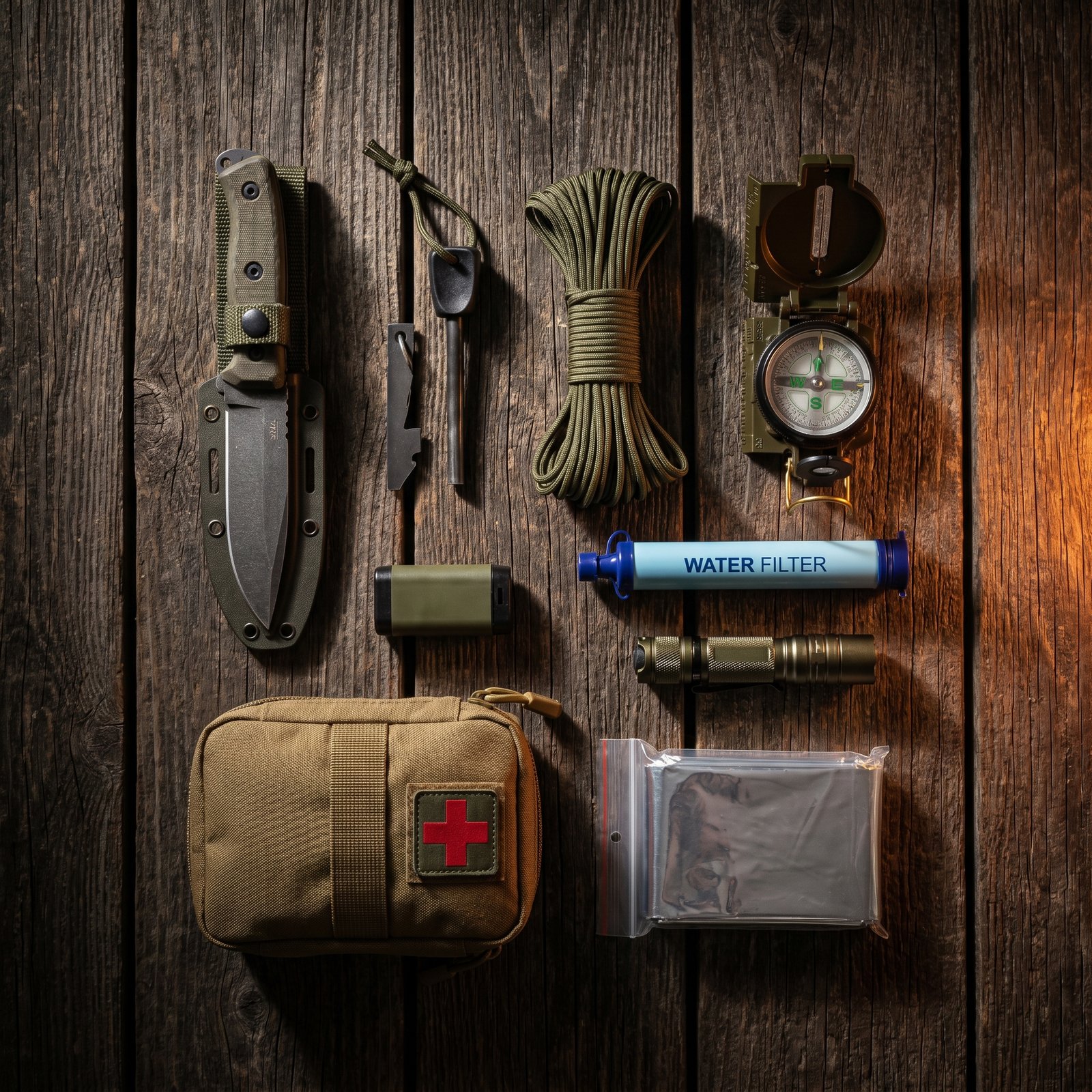

The wilderness doesn’t care how experienced you are. It doesn’t care about your plans, your fitness, or your good intentions. A sunny afternoon hike can turn into a freezing night out when a wrong turn leaves you off-trail as darkness falls. A routine camping trip can become a genuine emergency when a storm rolls in, an injury strikes, or you simply misjudge the conditions. In those moments, the gear in your pack stops being optional equipment and becomes the thin line between a great story and a tragedy.
Here’s the uncomfortable truth: most people who venture outdoors are dangerously underequipped. They carry snacks and a phone with no signal, assuming nothing will go wrong because nothing ever has. But the people who come home safe from genuine emergencies aren’t the lucky ones — they’re the prepared ones. They carry a thoughtfully assembled kit of survival essentials and, just as importantly, they know how to use every piece of it.
This guide cuts through the noise and the gimmicks to give you the 12 survival gear essentials that genuinely matter in 2026. These aren’t tacticool toys or marketing fluff — they’re the core tools that address the fundamental priorities of staying alive outdoors: warmth, water, shelter, signaling, and self-rescue. Whether you’re building a bug-out bag, a hiking kit, or a vehicle emergency stash, this is your foundation.
Let’s build a kit that brings you home. 🔥
Before assembling any kit, it helps to understand the core survival priorities that determine what truly matters, because good gear choices flow directly from these fundamentals. Survival in the outdoors comes down to addressing a handful of basic human needs in roughly this order of urgency.
The classic framework is often summarized through the rule of threes: a person can survive roughly three minutes without air, three hours without shelter in harsh conditions, three days without water, and three weeks without food. This hierarchy reveals what your gear should prioritize — protection from the elements and the ability to make fire and shelter come first, followed closely by water, with food a lower immediate concern in most short-term emergencies.
This is why the essentials below emphasize fire, shelter, water, and signaling above all else. Understanding these priorities keeps you from over-packing gimmicks while under-packing the tools that actually keep you alive. Every item on this list earns its place by directly addressing one of these fundamental survival needs.
If you could carry only one survival tool, a quality fixed-blade knife would be the one, and that’s why it tops our list of essentials. A good knife is the ultimate multitasker — it processes wood for fire and shelter, prepares food, cuts cordage, and handles countless tasks that arise in any outdoor emergency.
A fixed-blade design is preferred over a folding knife for serious survival use because it’s stronger, more reliable, and easier to clean, with no hinge to break or fail under hard use. A full-tang blade, where the metal extends through the entire handle, offers the durability to handle demanding tasks like batoning wood without snapping. The right size strikes a balance between heavy-duty capability and fine control.
This single tool underpins so much of wilderness self-reliance that mastering its use should be a priority for every adventurer. Pair a quality knife with the knowledge to use it safely and effectively, and you hold the foundation of bushcraft and survival in your hand.
Fire is survival’s great multiplier — it provides warmth, purifies water, cooks food, signals rescuers, and lifts morale — which makes a reliable fire-starting kit non-negotiable. As covered in our priorities, the ability to make fire ranks among the very first things to secure in an emergency, so this deserves a prominent place in any kit.
The golden rule is redundancy: carry multiple fire-starting methods so a single failure never leaves you without flame. A quality ferro rod provides thousands of fuel-free strikes that work wet and cold, while stormproof matches and a reliable windproof lighter serve as essential backups. Critically, include waterproof tinder — waxed cubes or petroleum-soaked cotton balls — that catches a spark instantly even in poor conditions.
With a layered fire kit, you can create warmth and flame in virtually any weather, addressing one of the most fundamental survival needs. Practice your fire-starting skills before you need them, because knowing how to build a fire in adverse conditions is just as important as carrying the tools to start one.
Water is among the most urgent survival needs, and since you can’t safely drink most found water raw, a reliable purification method is essential. Untreated wilderness water can harbor pathogens that cause debilitating illness — exactly what you can’t afford in a survival situation — so the ability to make water safe to drink is critical.
Modern portable water filters are compact, lightweight, and remarkably effective, removing bacteria and protozoa from natural sources so you can drink safely. Options range from straw-style personal filters to pump and gravity systems, while chemical purification tablets and the ability to boil water provide reliable backups that handle a broader range of threats. Carrying more than one method ensures you’re covered if a filter clogs or freezes.
Access to safe water dramatically extends how long you can survive and keeps you clear-headed and capable when it matters most. Given how little space a quality filter or a few purification tablets take up, there’s no excuse to venture out without a dependable way to make water safe.
Exposure to the elements can incapacitate or kill far faster than thirst or hunger, which is why emergency shelter ranks so high among survival essentials. Protection from cold, wind, and rain is a top priority, and the right lightweight gear can mean the difference between a survivable night and a deadly one.
A compact emergency bivvy or space blanket reflects your body heat back to you and packs down to almost nothing, making it effortless to always have on hand. A durable emergency tarp provides versatile shelter from rain and wind, and a length of strong cordage lets you rig it quickly. Together, these items let you create a protective microclimate that guards against hypothermia in harsh conditions.
Because shelter and warmth are so fundamental to survival, these lightweight items deserve a permanent place in every kit. They weigh and cost little, yet they directly address one of the fastest-acting threats in the wilderness, buying you the time and comfort to handle whatever else the situation demands.
When darkness falls, reliable light transforms a frightening, dangerous situation into a manageable one, making a quality flashlight or headlamp an indispensable survival tool. Navigating, setting up shelter, tending a fire, treating an injury, or signaling for help all become vastly harder — or impossible — without dependable light.
A headlamp is especially valuable because it keeps your hands free for the tasks at hand, while a compact flashlight offers a focused, powerful beam. Look for durable, water-resistant options with long battery life, and consider models with multiple brightness settings and an emergency strobe for signaling. Carrying spare batteries or choosing a rechargeable model with a backup power source ensures your light doesn’t fail when you need it most.
Reliable illumination touches nearly every aspect of nighttime survival, from safety to morale, and the compact size of modern lights means there’s no reason to be caught in the dark. A good headlamp is one of those simple essentials that proves its worth the first time the sun goes down on an unexpected night out.
Injuries happen outdoors, and the ability to treat them promptly can prevent a minor problem from becoming a life-threatening emergency, which is why a comprehensive first aid kit is essential. From cuts and blisters to sprains and more serious wounds, having the right supplies on hand lets you respond effectively when help may be hours or days away.
A well-stocked kit includes supplies for wound care and bandaging, blister treatment, pain relief, and any personal medications you depend on, along with tools like tweezers and medical tape. Beyond the basics, items for managing more serious bleeding and the knowledge to use them can be lifesaving in a genuine emergency. Tailoring your kit to your activities, group size, and trip length ensures you carry what you actually need.
Just as important as the supplies is knowing how to use them, so basic first aid knowledge is a worthy investment for any adventurer. A thoughtful first aid kit, combined with the skills to use it, turns you into someone who can handle the injuries that the outdoors inevitably presents.
Getting lost is one of the most common ways outdoor outings turn into emergencies, making reliable navigation tools a core survival essential. While phones and GPS devices are useful, they fail when batteries die or signals vanish, so a traditional map and compass — and the skill to use them — remain irreplaceable.
A detailed topographic map of your area paired with a quality compass lets you determine your position, plan routes, and find your way back to safety without relying on electronics. These tools never run out of battery and work anywhere, providing a dependable fallback when technology lets you down. Learning to read terrain and take a bearing transforms these simple tools into a powerful means of self-rescue.
Navigation skill is one of the most valuable abilities an adventurer can develop, and the lightweight, foolproof nature of a map and compass makes them essential backups even in the GPS era. Knowing where you are and how to get home is fundamental to coming back safe from any wilderness outing.
Few items are as endlessly useful in a survival situation as strong cordage, which is why a length of quality paracord earns its place among the essentials. Cordage solves an astonishing range of problems — rigging shelter, securing gear, replacing broken laces, fashioning tools, and dozens of improvised uses limited mainly by your creativity.
Genuine paracord is prized for its strength and its inner strands, which can be separated out for finer tasks like fishing line, sewing, or snares, effectively giving you many cords in one. Carrying a generous length, or wearing it as a survival bracelet, ensures you always have this versatile resource available. Its light weight and compact form mean there’s little reason not to include plenty in your kit.
The true value of cordage reveals itself in the field, where improvisation often determines success, and a strong, versatile line becomes the thread that holds your shelter, gear, and solutions together. It’s a humble item that proves indispensable again and again.
A quality multi-tool packs the functionality of an entire toolbox into a pocket-sized package, making it one of the most practical survival essentials you can carry. Pliers, blades, screwdrivers, scissors, and more combine in a single compact unit that handles repairs, gear adjustments, and countless small tasks that arise outdoors.
The versatility is the point — a good multi-tool lets you fix equipment, process food, cut materials, and tackle improvised challenges without carrying a bag full of separate tools. For gear maintenance in the field, from tightening a loose stove to repairing a pack, a multi-tool is often exactly what saves the day. Choosing a durable, reputable model ensures it holds up to real use when you depend on it.
While a fixed-blade knife handles heavy cutting, the multi-tool covers the wide array of smaller jobs that fill any outdoor adventure. Together they form a complementary pair, and the multi-tool’s compact versatility makes it a constant companion worth its modest weight many times over.
When you need rescue, the ability to signal for help dramatically improves your chances of being found, making signaling devices a crucial survival essential. In an emergency, attracting attention quickly and over distance can be the deciding factor in a successful rescue, so these lightweight tools deserve a place in every kit.
A loud emergency whistle carries far further than your voice and requires little energy to use, allowing you to signal for help repeatedly even when exhausted. A signal mirror can flash sunlight to catch the attention of distant searchers or aircraft, and a brightly colored item or light helps rescuers spot you. For remote travel, a dedicated emergency beacon or satellite communicator can summon help from truly isolated locations.
These simple tools turn a passive wait for rescue into an active effort to be found, and their minimal weight makes them effortless to carry. Knowing how to signal effectively — and having the means to do so — is a vital part of any survival plan, especially when venturing far from established trails.
While you can survive longer without food than without water or shelter, maintaining energy keeps you clear-headed and capable, making emergency rations a worthwhile survival essential. In a stressful situation, calories fuel the decision-making, warmth, and physical effort that survival demands, so a reserve of compact, high-energy food has real value.
Lightweight, calorie-dense options like energy bars, dried foods, and dedicated emergency rations provide sustenance without taking much space or weight in your pack. These shelf-stable foods require no preparation and deliver quick energy when you need to stay sharp and keep moving. Including a small reserve beyond what you plan to eat ensures you’re covered if your trip extends unexpectedly.
Though food is a lower immediate priority than fire, shelter, and water, the morale and energy boost it provides shouldn’t be underestimated in a genuine emergency. A few compact, high-calorie items tucked into your kit keep your body fueled and your mind clear, supporting every other aspect of self-rescue.
All the gear in the world does you no good if you can’t carry it comfortably and access it quickly, which is why a durable, well-designed backpack rounds out our essentials. Your pack is the foundation that holds your entire kit together, and a quality one makes carrying your gear comfortable and organized.
A rugged, appropriately sized backpack with comfortable straps and thoughtful organization lets you transport your survival essentials over distance without exhausting yourself. Durable materials and construction ensure it survives the rough handling of outdoor use, while accessible pockets keep critical items within quick reach when seconds count. Choosing a pack suited to your activities and the volume of gear you carry ties your whole system together.
A good backpack transforms a pile of gear into an organized, portable survival system you can rely on. It’s the unglamorous but essential piece that makes everything else usable in the field, ensuring your carefully chosen tools are always with you and ready when the situation demands them.
Owning the right gear is only half the battle — organizing it thoughtfully and tailoring it to your needs is what turns a collection of items into an effective survival system. A well-built kit is matched to your environment, activities, and skill level, neither overloaded with gimmicks nor missing crucial essentials.
Start by prioritizing the core needs — fire, shelter, water, signaling, and first aid — then build outward based on your specific trips and conditions. Organize items so the most critical tools are quickly accessible, group related gear together, and protect moisture-sensitive items in waterproof containers. Keep a compact version of your essentials on your person, separate from your main pack, so losing your bag doesn’t leave you without the basics.
Just as important, practice using your gear before you need it, because the moment of an emergency is the worst time to learn how a tool works. Familiarity with your kit, combined with fundamental survival skills, is what ultimately keeps you safe. The best survival gear in the world is only as good as the person wielding it.
Let’s bring it all together. The twelve essentials above — anchored by a reliable knife, a redundant fire-starting kit, water purification, and emergency shelter — address the fundamental survival priorities that keep you alive when things go wrong outdoors. Build your kit around these core needs first, then customize it to your environment, activities, and the length of your adventures.
Remember that gear alone isn’t enough. The most prepared adventurers pair quality equipment with the knowledge and practice to use it, turning tools into genuine capability. Take the time to learn fire-starting, navigation, first aid, and shelter-building, and your kit becomes exponentially more valuable. Skills weigh nothing and never run out.
The wilderness will always be unpredictable, but you don’t have to be unprepared. Assemble these essentials, master their use, and carry them every time you head outdoors. Do that, and you transform yourself from someone who hopes nothing goes wrong into someone genuinely ready to handle it when it does — which is exactly the kind of person who comes home safe.
Gear up, skill up, and adventure with confidence. 🔥
Found this guide helpful? Share it with your fellow adventurers and explore our other reviews on fire starters, camping stoves, and emergency kits — your complete resource for fire, fuel, and outdoor survival.




No Comments